
Should Every Service Have Its Own Page?
When to split services into separate pages, when to combine them, and what each page should contain.

The single "Services" page with a bullet list is the most common structural mistake on small business websites. It feels tidy. It just doesn't work for the people trying to find you.
Why separate pages work better
Search matches pages, not businesses. Someone searching "hot water system replacement" is far more likely to be shown a page about hot water systems than a general services page that mentions it in a list.
You can answer the actual question. A dedicated page has room for what the job involves, what it costs, how long it takes and what happens next. A bullet point has room for three words.
Relevant proof. Deck photos on the decking page. Switchboard photos on the switchboard page. Reviews that mention that exact job.
Clearer measurement. When each service has a page, you can see which ones bring enquiries and which don't.
When to combine instead
- The services are the same job with different names - "drain cleaning" and "drain clearing".
- You'd have nothing distinct to say beyond a paragraph.
- It's a service you don't especially want more of.
- You couldn't keep the page current.
Two thin pages are worse than one solid page. The test is whether you can write something genuinely useful and different.
What belongs on a service page
- A heading using the words customers use, not industry terms.
- A short opening that confirms they're in the right place.
- What the job involves, step by step.
- Signs they need it, or reasons people book it.
- What it typically costs, or what drives the price.
- How long it takes and what your lead time is.
- Photos of that specific type of work.
- A review that mentions that job.
- Areas you do it in.
- One clear call to action.
Aim for depth over length. Six hundred useful words beats two thousand padded ones.
Keep the structure simple
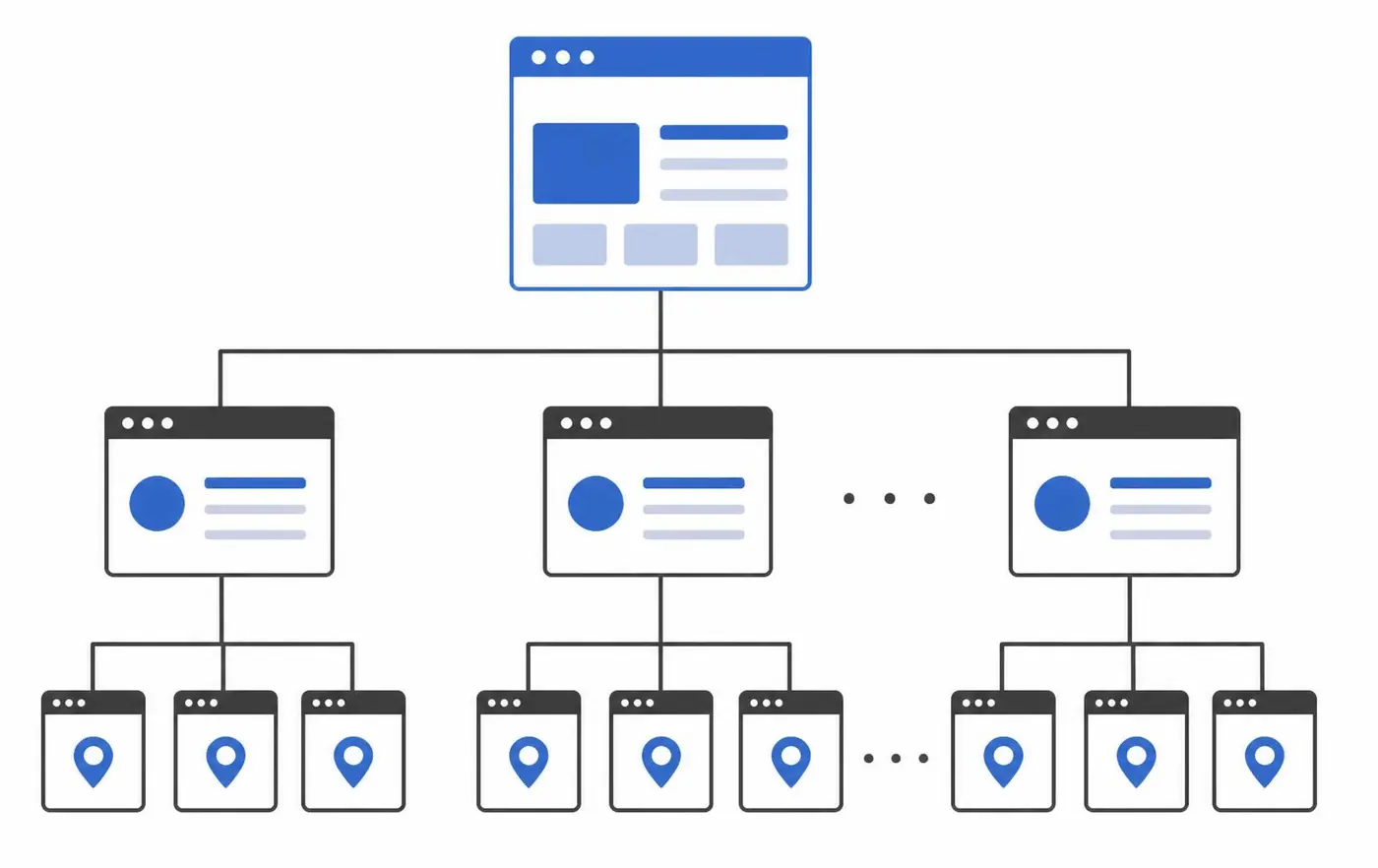
A services overview page linking to each individual service page, with each service page linking back and across to related ones. Every service page should also be reachable from the main menu or a services dropdown.
The mistake to avoid
Don't create ten service pages by copying one and swapping the service name. Near-identical pages help nobody, and they make the whole site look thin. If you can't say something real about a service, leave it as part of a combined page for now.
Before you split a service out
- You want more of this work
- People search for it by name
- You can write 500+ genuinely useful words about it
- You have photos of that specific work
- It's meaningfully different from your other services
Related reading: how many pages a small business website needs and service pages vs location pages.
Every build includes a page per service you actually want more of - see tradie website design or, for a single trade, website design for plumbers.
Want to Improve Your Google Visibility?
SEO varies enormously depending on your website, your market and who you're competing against, so there's no fixed package. Tell me what you do and where you work, and I'll tell you honestly what's realistic.
Talk to Mike About SEOCommon questions
- How many service pages is too many?
- There's no hard limit, but if you can't keep them current or can't say something distinct on each, you've gone too far. Quality decides, not quantity.
- Should service pages be in the main menu?
- Yes - either directly or under a services dropdown. Pages that can only be reached by search are harder for both visitors and search engines.

Written by Mike - Web Guy Mike
I build and look after websites for Australian tradies and small service businesses. Every site is built by me - no outsourcing, no account managers. More about Mike.